Midwest Yodeling Archive
Explore the timeline, maps, and forgotten posters that tell the story of hopscotch yodeling across the Midwest, from small-town fairs to state championships.
The History of Hopscotch Yodeling: From Alpine Ridges to City Grids
Welcome to the official home of Hopscotch Yodeling (HY). While often met with a raised eyebrow or a playful grin, our sport is far from a modern prank. It is a rigorous discipline born from the intersection of two ancient traditions: the communicative power of the human voice and the physical precision of the hopscotch grid.
Below is the definitive history of how a rugged survival skill transformed into an elite urban athletic pursuit.
I. The Ancient Roots: 10,000 BCE – 1800s
The two halves of our sport began worlds apart.
- The Voice: Yodeling is one of humanity’s oldest forms of communication. Originating over 10,000 years ago, it was a “homemade Morse code” for herders in the Swiss Alps, the Appalachian Mountains, and beyond. It allowed individuals to communicate across vast distances, using the passaggio (the break between vocal registers) to cut through wind and terrain.
- The Grid: Hopscotch traces its lineage back to the Roman Empire, where it began as a grueling military training exercise. Roman soldiers would run 100-foot courses in full armor to improve footwork and agility. Children soon imitated these drills, scaling them down into the chalk-drawn grids we recognize today.
II. The Accidental Fusion: The Mid-19th Century
The “Big Bang” of Hopscotch Yodeling occurred in the mid-1800s during the great migrations to North America. In tight-knit immigrant communities—particularly in the Midwest and the Ohio River Valley—traditional European yodeling collided with urban street games.
Oral tradition suggests that the first “Fused Performance” occurred when a traveling yodeling minstrel was challenged to navigate a children’s hopscotch grid without breaking his vocal run. The crowd was mesmerized by the coordination required to maintain a perfect head voice while performing high-impact physical jumps. Thus, a niche entertainment act was born.
III. The Formalization: 1950s – 1970s
Following World War II, the sport saw a massive resurgence in urban parks.
- The “Schuhplattler Hop”: In the 1950s, practitioners began incorporating rhythmic elements from Bavarian Schuhplattler dancing into their footwork.
- Divisional Recognition: By the late 1960s, informal “Divisional Championships” began appearing in cities with strong German-American roots. It was during this era that the Golden Thread Rule (prohibiting silence during the run) was officially codified to distinguish the sport from mere playground play.
IV. The Modern Era: 2026 and Beyond
After a quiet period in the late 20th century, Hopscotch Yodeling has entered a “High-C Revolution.” The advent of social media allowed the world’s most remote practitioners to share techniques, leading to a surge in technical difficulty.
Today, the sport is recognized for its incredible cardiovascular and cognitive demands. It is no longer just a “quirky tradition”—it is a testament to human coordination. Whether you see it as a joke or a masterpiece, one thing is undeniable: once you hear the trill and see the hop, you are witnessing thousands of years of history in motion.
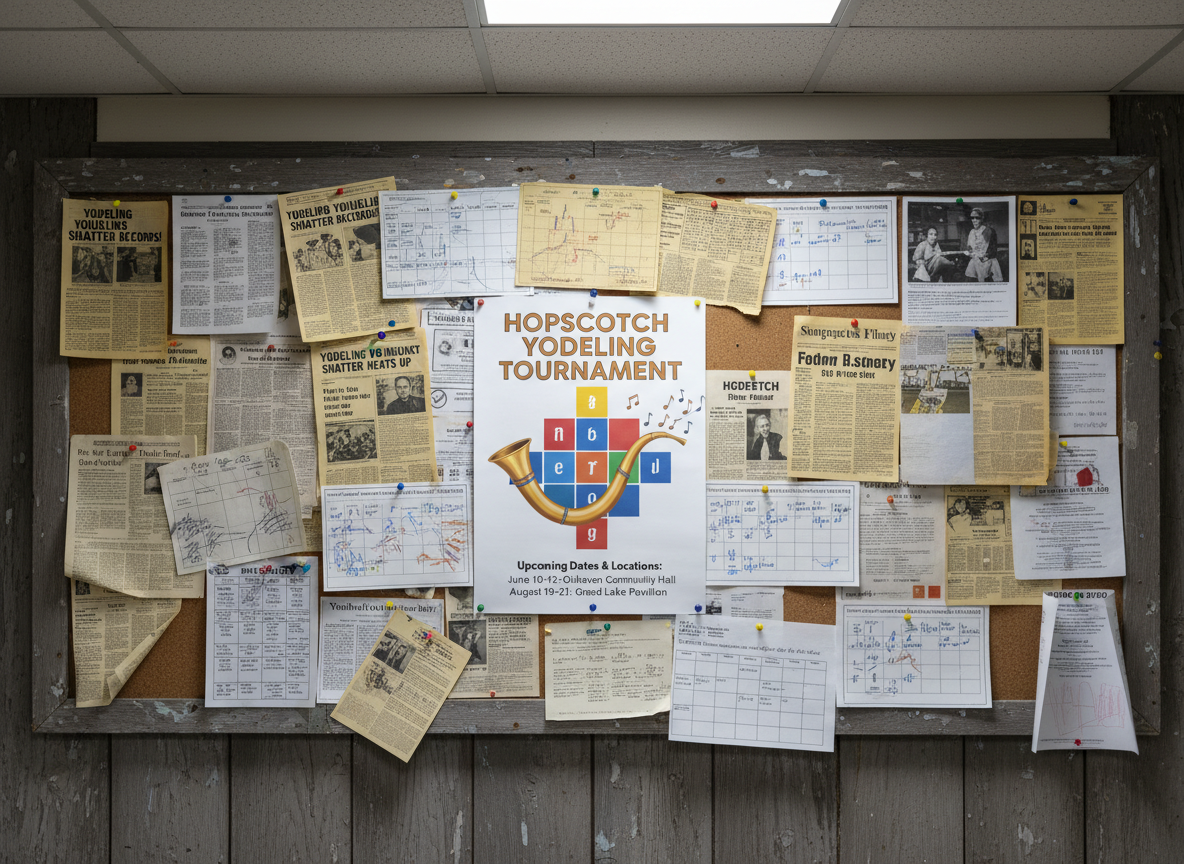
Archive Overview
This historical archive gathers Midwest hopscotch yodeling records, spanning early 1900s to modern regional contests, highlighting eras, communities, and notable competitors; explore detailed results on the Results page.

Showcase historic photos, posters, score sheets, and memorabilia from past Midwest Hopscotch Yodeling events to bring the archive to life visually.


 Competitive Hopscotch Yodelers Hub