
Begginers Guide
The Path to the Apex: A 6-Week Beginner’s Training Schedule
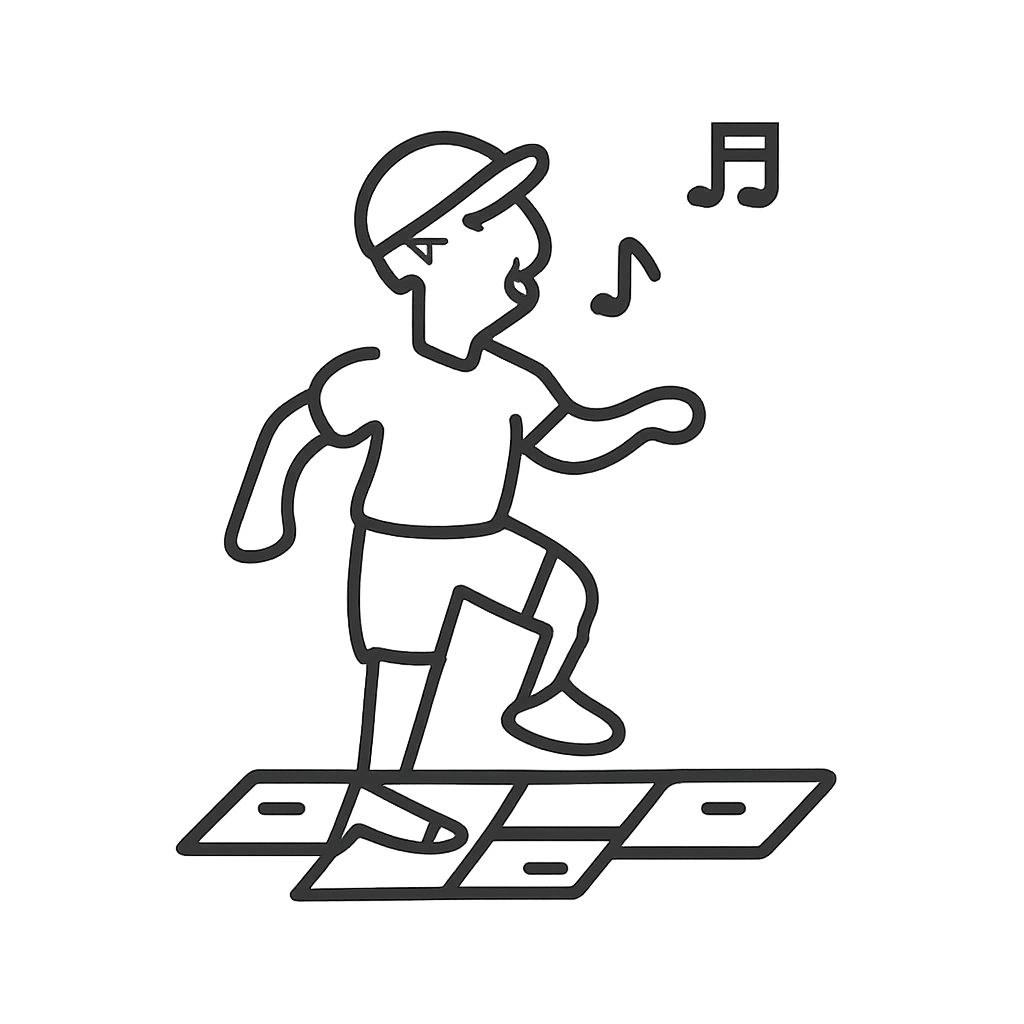
Transitioning from a casual hopper to a sanctioned Yodel-Athlete requires a dual-track approach. You cannot simply “add” yodeling to hopscotch; you must rebuild your respiratory system and muscle memory to act as a single unit.
Phase I: Respiratory Anchoring (Weeks 1–2)
Before you touch a chalk grid, you must master the Static Passaggio.
- The “Silent Hop”: Practice the 10-square sequence in total silence. Focus on landing in the center of the squares with minimal “thud.” The quieter your feet, the more air you preserve for your lungs.
- Register Breaking: Spend 15 minutes a day jumping rope while alternating between your “chest” and “head” voice.
- Goal: Eliminate the “gasp” between register shifts.
Phase II: The “Golden Thread” Introduction (Weeks 3–4)
Now, we introduce the vocal requirement to the physical movement.
- The Low-Tempo Run: Navigate the grid at 50% speed. You must maintain a continuous, low-volume hum throughout the entire run. If the hum breaks when your foot hits the ground, reset.
- Marker-Retrieval Breathwork: Practice the “One-Foot Lean.” Lower yourself to pick up the marker while holding a single, steady note. This is where most novices lose their pitch due to core compression.
Phase III: Integration and Speed (Weeks 5–6)
This phase prepares you for the “Apex” and competitive scoring.
- The “Apex” Hold: Set a timer. Navigate to Square 10 and hold a high-falsetto trill for as long as possible while balancing on one foot.
- Target: 8 seconds of sustained, clear yodeling.
- Rhythmic Synchronization: Use a metronome set to 100 BPM. Every hop must land on a beat, and every “yodel-lay-hee” must span exactly four beats.
Essential Gear for the Novice
- Hydration: Lukewarm water with lemon (cold water constricts the vocal cords).
- Flat-Sole Trainers: Avoid “clunky” running shoes; you need to feel the lines to avoid “Static Step” penalties.
- The “Practice Puck”: Use a heavier beanbag initially; it’s less likely to bounce, allowing you to focus on your vocals.
Corrections Submissions
Submit corrections or missing results via the form below to keep the archive accurate and professionally maintained for Midwest hopscotch yodeling.
Your submission should include competition name, year, division, and any supporting sources to help volunteers verify and update the records promptly.



 Competitive Hopscotch Yodelers Hub