Competition Rules
Explore the rules and documentation that govern Midwest Hopscotch Yodeling competitions, with sections on layouts, timing, scoring, and judging criteria.
The Official Compendium of Hopscotch Yodeling: Rules & Regulations
Whether you are practicing on a quiet suburban driveway or competing in a high-stakes divisional tournament, Hopscotch Yodeling (HY) requires a perfect marriage of the “Head” and the “Hoof.” This guide serves as the universal standard for enthusiasts and athletes worldwide.
I. The Arena (The Grid)
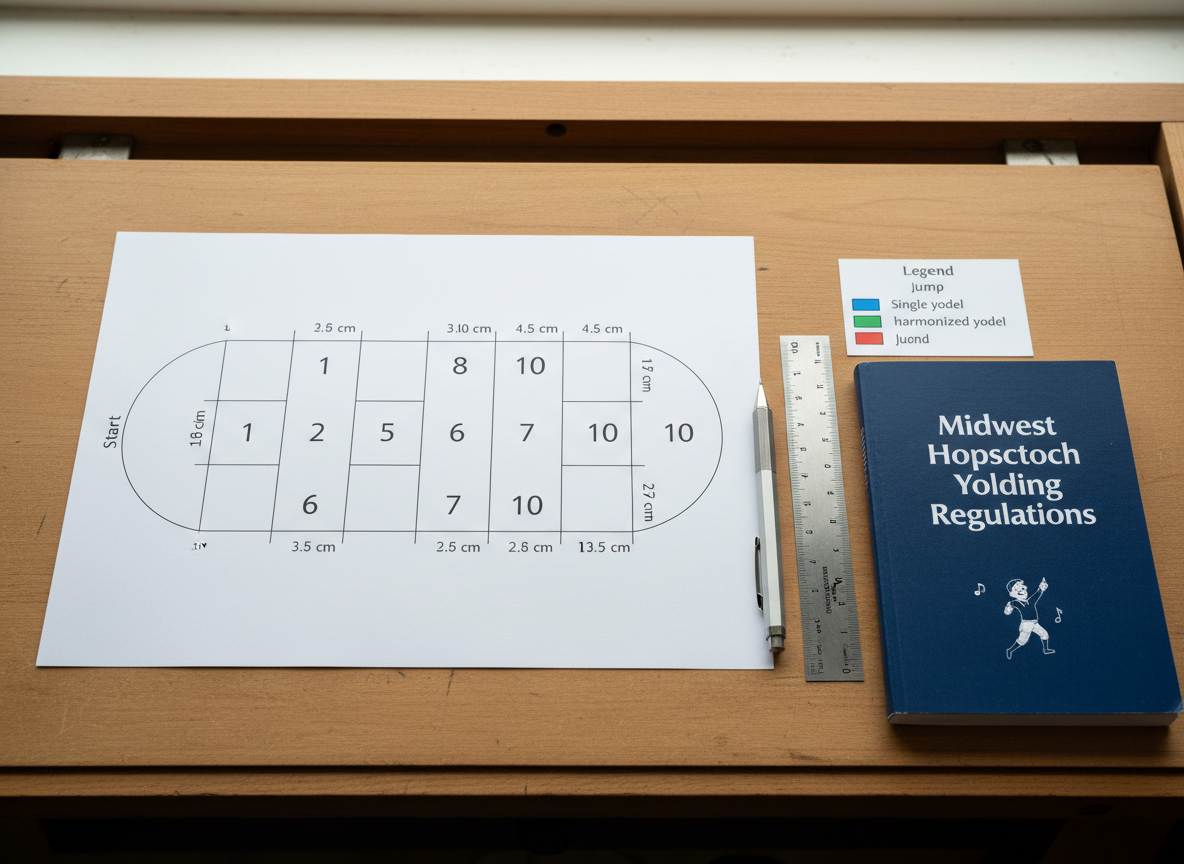
The field of play must be a standard ten-square linear grid.
- Dimensions: Squares should be approximately 15 to 18 inches. Smaller squares increase the “Technical Difficulty” (TD) score but also raise the risk of “Static Step” penalties.
- The Vocal Apex: The semi-circular “10” square at the top of the grid. Per regulation, this square requires a sustained “High-Yodel” (falsetto) for no less than three seconds before the return trip begins.
II. Equipment
- The Marker (The “Puck”): A flat stone, wooden disc, or leather-bound beanbag. It must be heavy enough not to bounce out of a square but light enough for a precise toss.
- Footwear: Low-profile athletic shoes with high lateral support are recommended to prevent ankle rolls during rhythmic transitions.
- The Voice: No electronic amplification is permitted. The acoustic output must be entirely natural.
III. The Fundamental Laws of Play
1. The Continuous Trill (The “Golden Thread”)
The most sacred rule of HY is the Golden Thread. The yodel must begin the moment the marker leaves the player’s hand and cannot cease until the player hops back across the starting line.
- The Break: Any unintentional silence exceeding 0.5 seconds results in an immediate “Vocal Void” penalty.
- Passaggio Transitions: Players must shift between their chest voice (lower register) and head voice (higher register) at least once per square traveled.
2. Physical Navigation
The athlete follows standard hopscotch progression:
- The Toss: The marker must land entirely within the target square. If it touches a line, the turn is forfeited.
- The Hop: Single squares require one foot; side-by-side squares (e.g., 4 and 5) require two feet planted simultaneously.
- The Retrieval: The player must pause on one foot to pick up their marker on the return trip without losing their vocal register.
IV. Scoring & Penalties
Scoring is judged on a 100-point “Perfect Performance” scale:
| Category | Description | Points |
| Vocal Integrity | Purity of tone and lack of unintended “cracks.” | 40 |
| Grid Precision | Perfect landings in the center of squares; clean tosses. | 30 |
| Rhythmic Sync | Timing the “hops” to the beat of the yodel melody. | 20 |
| The “Apex” Hold | Complexity and duration of the vocal run in Square 10. | 10 |
Standard Penalties:
- Static Step (-5 pts): Touching a chalk line with any part of the shoe.
- The Mute (-10 pts): Forgetting to yodel while retrieving the marker.
- Technical Fall (DQ): Touching the ground with a hand or second foot to stabilize.
V. Common Misconceptions
Because of its joyful appearance, Hopscotch Yodeling is often dismissed as a joke. However, the physiological toll is significant. Maintaining a clear passaggio while the heart rate is elevated from jumping requires years of cardiovascular and vocal training. A true practitioner treats the grid as a stage and the sidewalk as a gymnasium.
Rule Updates
Stay informed about rule changes, clarifications, and judging guides to keep all stakeholders up-to-date with official standards.

 Competitive Hopscotch Yodelers Hub